
Investing in US stocks has become quite popular among Indian investors. Earlier, buying shares of favorite companies like Apple, Microsoft, Nvidia, Amazon, Google, Tesla, etc. seemed difficult & was accessible only to HNIs & institutions. Today, there are platforms such as Vested and INDmoney that have made global investing simple and accessible.
Both platforms allow Indians to invest in US stocks from the comfort of their homes. However, they differ in terms of fees, ease of use, features, tools, and the overall investing experience. In this post, we will cover a detailed comparison of Vested and IndMoney- their fees and charges, pros & cons of each platform, etc.
Why Invest in US Stocks from India?
Before we dive into the actual comparison, let us just revisit briefly why one should invest in US Stocks (or for that matter international stocks) from India. Below are the main reasons:
- Diversification– Most retail investors already have significant exposure to Indian equities & mutual funds. US stocks provide geographical diversification.
- Access to Global Leaders– The US stock market hosts some of the world’s biggest companies with a strong moat like Apple, Microsoft, Amazon, Alphabet, Nvidia, Meta, Tesla, etc. These businesses have a strong influence in their niche.
- Dollar-Based Wealth Creation– Investments are denominated in US dollars. This can potentially benefit investors if the Indian rupee depreciates over time.
- Access to Innovative Sectors– Many innovative companies are not available in the domestic markets & are listed only in the international markets. Examples- AI, semiconductor, biotech, etc.
Overview of Vested
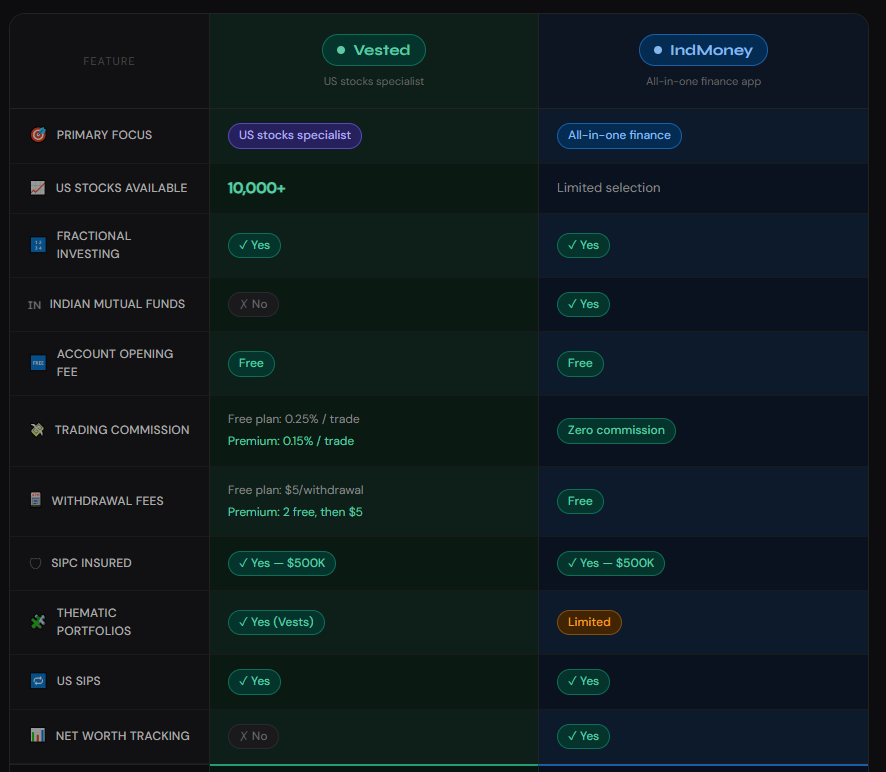
Vested is one of India’s first dedicated platforms for US stock investing. Founded specifically for global investing, Vested enables Indian investors to buy more than 10000 US-listed stocks and ETFs through regulated brokerage partnerships in the United States. It also offers a thematic portfolio- basket of stocks grouped by theme (tech, clean energy, EV, etc.). They claim to have Rs.10,000 Crores assets under management as of December 2025.
Vested Finance Fees and Charges
Vested offers 2 plans- Basic & Premium. Details of them are as below:
Basic Plan (Free)
- Account opening: Free
- Brokerage on trades: 0.25% per transaction (capped at $35)
- Withdrawal Fees: $5/withdrawal
Premium Plan
- Subscription: ₹4,500/year (or ₹375/month)
- Brokerage on trades: 0.15% per transaction (capped at $35)
- Withdrawal Fees: 2 free withdrawals- $5/withdrawal thereafter
- Advanced features unlocked (more signals, priority support)
Is Vested Safe and Regulated?
Vested Finance is registered with the US Securities and Exchange Commission (SEC) and is a member of FINRA (Financial Industry Regulatory Authority). Each account is insured by SIPC up to $500,000.
Overview of INDmoney
INDmoney initially started as a wealth-tracking platform and later expanded into investing services. It positions itself as a full-stack personal finance app to buy global & Indian stocks, Indian mutual funds, track your investments in FDs, manage loans, expenses, pay credit card bills & do a lot more.
INDmoney Fees and Charges
Following are INDmoney brokerage fees & charges for global stocks
Basic Plan (Free)
- Account opening: Free
- Brokerage on trades: 0.25% per transaction (capped at $25)
- Withdrawal Fees: Free
Is INDmoney Safe and Regulated?
INDmoney is SEBI-registered, which gives it a regulatory advantage in the Indian context. It also uses DriveWealth as its US brokerage partner, so your US investments are SIPC-insured up to $500,000.
Other Costs & Fees Involved in Global Investing
The real cost of investing in US stocks from India has three constituents (irrespective of the platform you choose)
1: Brokerage Charges
These are charged by the platform. Vested offers 0.25% on Free Plan & 0.15% on Premium (capped at $35/trade) whereas INDmoney charges 0.25% per transaction (capped at $25). For most small investors making a few trades a month, this difference is minimal.
2: Forex Conversion Charges
This is the biggest charge involved. When you send money from your Indian bank account to your Vested or IndMoney account, your bank converts INR to USD. Banks typically charge a forex markup (around 2-5%) on top of the RBI reference rate. Both Vested and IndMoney have negotiated better rates with partner banks. If you use these partner banks, your forex charges can be reduced significantly.
3: TCS on Remittances Above ₹10 Lakh
Under LRS, if you remit more than ₹10 lakh in a financial year for investment purposes, a 20% TCS is deducted on the excess amount. This money is refundable when you file your ITR- but it does reduce your investable amount temporarily. Plan your remittances accordingly across the financial year to manage this.
Conclusion
Both Vested and INDmoney are good platforms to buy US stocks in India. However, the right choice depends on your investing style.
In my opinion, if you are looking for an all in one kind of finance app with global investing, INDmoney is an ideal choice. On the other hand, if you want to invest significantly in US stocks & ETFs & require more tools, features, etc. Vested is also a good choice.
Ultimately, both platforms have helped thousands of Indians access global markets. The best platform is the one that aligns with your investment goals, preferred user experience, and long-term wealth-building strategy.
