
Real estate is one of the most favorite & preferred investment options for Indians. For decades, buying property has been considered one of the safest ways to build wealth and earn regular income through rents. Traditionally, people invested in flats, shops, or office spaces. However, in recent times, Real Estate Investment Trust (REITs) have emerged as a modern alternative for investors who want exposure to real estate without getting into the hands-on experience of buying & managing a physical property.
In this article, we will understand what exactly REITs and rental properties are in simple language, compare REIT vs Rental Property in India based on factors like- returns, risks, liquidity, taxation, and income potential, etc.
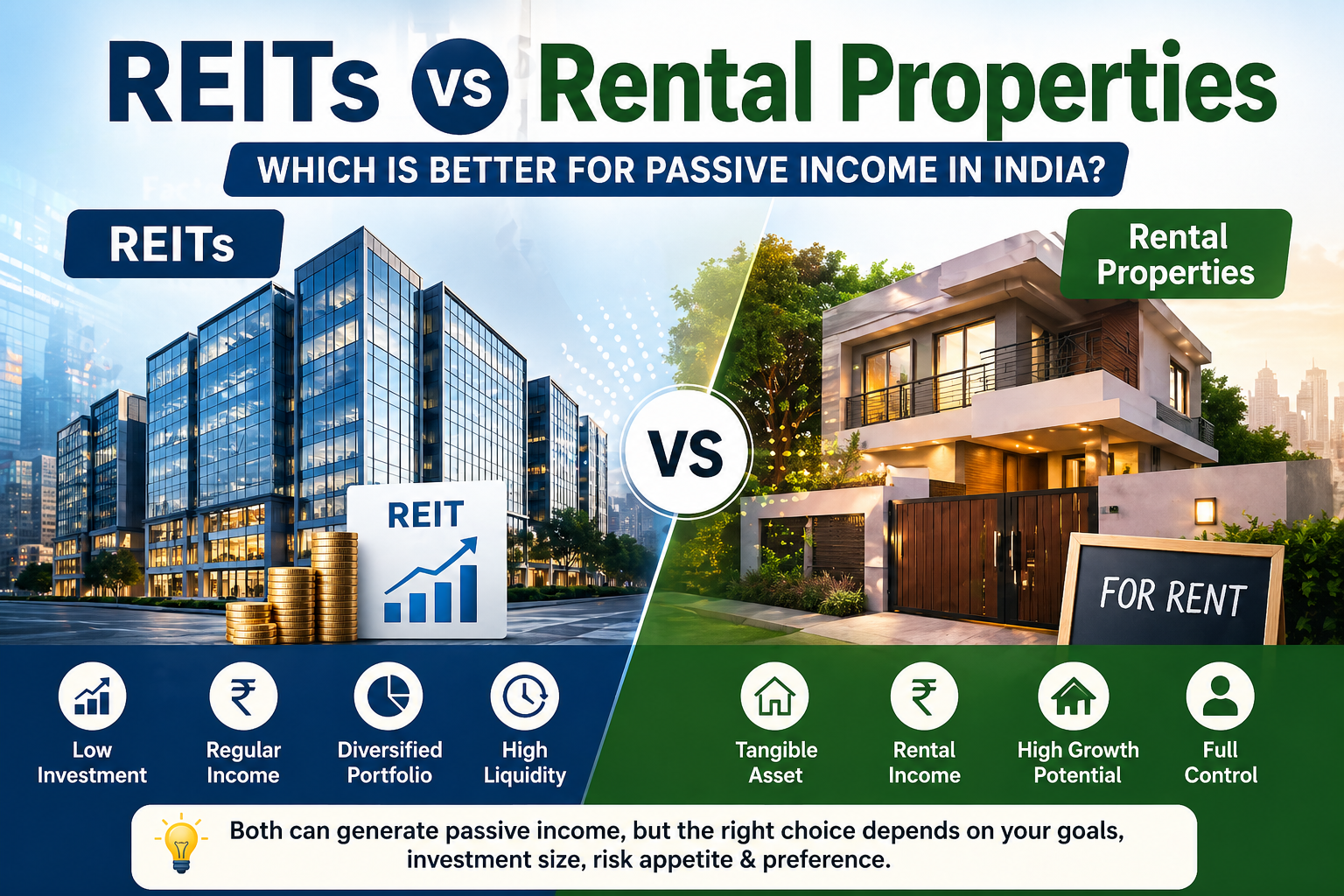
What is a Real Estate Investment Trust (REIT)?
A Real Estate Investment Trust (REIT), in simple words, is a company that owns a large pool of income-generating properties like malls, office parks, warehouses, etc. It pools money from thousands of investors, buys/develops & maintains these properties, earns rent from them, and distributes most of that rent back to investors as dividends.
You can buy and sell REIT units on the stock exchanges- just like normal stocks. As per SEBI regulations, Indian REITs must distribute at least 90% of their net distributable cash flows to investors. This means that you get regular income without owning or managing any property yourself.
Types of REITs in India
- Office REITs – Own Grade-A office parks leased to corporates, large IT and BFSI companies. Examples: Embassy REIT, Mindspace REIT, Brookfield REIT.
- Retail REITs – Own premium shopping malls. Example: Nexus Select Trust.
- Small & Medium REITs – A considerably newer type introduced in March 2024 after SEBI framework. Covers smaller commercial assets worth ₹50 crore or more. Expected to grow significantly in coming years.
Rental Properties in India- Commercial & Residential
1. Residential Rental Property
You buy a flat or house (essentially a residential unit) and rent it to families or working professionals. This is the most common form of property investment in India.
Example: You buy a 2BHK flat in the outskirts of Pune for ₹60 lakhs. You rent it out for ₹18,000 per month. Your annual gross rental income (without the expenses like maintenance) is ₹2.16 lakhs- a rental yield of roughly 3.6%.
2. Commercial Rental Property
You buy an office space, shop, or warehouse and rent it to a business. Commercial properties typically offer higher rental yields than residential ones, but they cost significantly more upfront.
Example: A small commercial office in a Tier-1 city might cost ₹1.5–2 crore and yield 5–6% annually.
REIT vs Rental Property: Head-to-Head Comparison
Below table will help you understand detailed comparison between REITs & rental properties.
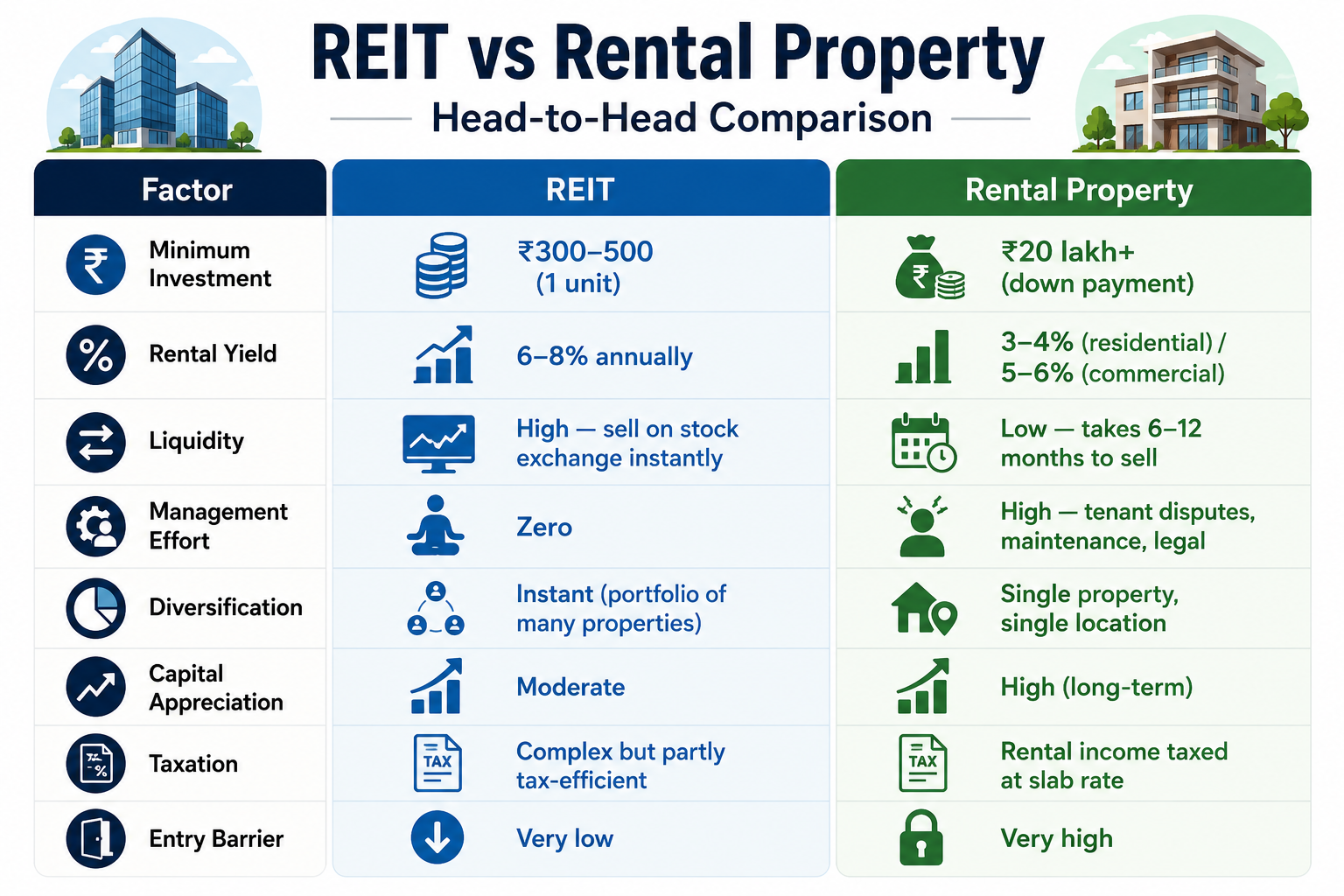
REIT vs Rental Property: Yields Comparison
Rental yields in major Indian cities average 2-5% annually. Bengaluru rental yields are around 3–4%, while Mumbai and Gurugram are near 4–4.5% (indicative figures- rates will vary on individual properties). These are approximate gross yields – before maintenance costs, interest costs (if financed on bank loans), property tax, and vacancy periods.
REITs currently deliver 6–8% annual returns from distributions alone, plus potential unit price appreciation.
Let us understand this with an example. Suppose you have 50 lakhs to invest.
Option A- Residential Flat in Bengaluru
- Rental income: ₹14,000–16,000/month
- Annual gross income: ~₹1.8 lakhs
- Yield: ~3.5%
- Pro: potential property appreciation
- Con: Maintenance, property tax, tenant issues, low liquidity
Option B- Investment in REITs
- Annual distribution income: ~₹3–3.75 lakhs (at 6–7.5% yield)
- Monthly income: ~₹25,000–31,000
- Pro: No maintenance, no tenant calls, almost instant liquidity
As can be seen from the above example, the income difference is significant. REITs can potentially generate nearly double the monthly income of a residential rental property. However, note that these are indicative yields and the rates might vary.
Top 5 REITs in India
Embassy Office Parks REIT (EMBASSY)- India’s first and largest REIT, listed in 2019. Backed by Embassy Group and Blackstone. It owns ~51 million sq ft of Grade-A office parks in Bengaluru, Mumbai, Pune, and NCR. Occupancy: ~92%.
Mindspace Business Parks REIT (MINDSPACE)- Backed by the Raheja Group. Owns ~34 million sq ft of premium offices across Mumbai, Hyderabad, Pune, and Chennai. It has the lowest volatility among listed REITs and strong geographic diversification. Tenants include Accenture, Barclays, and Deloitte.
Brookfield India Real Estate Trust (BIRET)- India’s only 100% institutionally managed office REIT, backed by Brookfield Asset Management — one of the world’s largest real estate managers. Occupancy improved from 82% to 92% in FY26.
Nexus Select Trust (NEXUS)- India’s first and only listed retail mall REIT. Owns 19 premium malls across 15 cities. Occupancy stands at a remarkable 97.2%. Recorded ₹124 billion in tenant sales in FY25.
Knowledge Realty Trust- The newest listed REIT, listed in 2025 with primarily commercial assets. Still early in its track record but expanding its portfolio.
Best REIT Mutual Funds in India
Well, in case you are looking for Best REIT Mutual Funds in India , unfortunately, there is no dedicated REIT-only mutual fund in India right now. No AMC has launched a fund that invests purely in Indian REITs as yet
Alternatives to REITs in India
REITs and rental properties aren’t the only options to invest in real estate in India. Here are two more options worth knowing.
Fractional Real Estate Investing
You buy a slice of a premium property — not the whole thing. Platforms like AltDRX, PropShare, and hBits pool money from investors, buy the asset, and distribute rental income to you proportionally. Through AltDRX, investors can start with as little as ₹10,000 and own shares in premium properties across Mumbai, Bangalore, Goa, Kerala, Pune, and Hyderabad — with no property management headaches. Yields on quality fractional real estate investments typically range from 7–10% annually. SEBI-regulated SM REITs (from platforms like PropShare and hBits) take this a step further — listed on the stock exchange, with minimum investments of ₹10 lakh and projected yields of 8–12%.
Real Estate Stocks & Mutual Funds
Want real estate exposure through your regular investment account? Invest in listed property companies like DLF, Prestige Estates, Godrej Properties, or Phoenix Mills — directly via demat or through real estate thematic mutual funds. No mandatory dividends like REITs, but you get equity-style exposure to India’s property growth story. You can start with a SIP of just ₹500.
Conclusion
REITs and rental properties are both good options to invest in real estate in India. But they serve different purposes.
REITs are better for passive income right now. They offer comparatively higher yields, zero management hassle, full liquidity, and a low entry barrier. Anyone with even as low as ₹300 and a demat account can start investing in real estate.
Rental property is better for those who have the ability to handle the upfront high cost, the active management of the property, and hold the property for a considerable time for significant capital appreciation.
Smart investors are working with both- Start small with REITs. When the time and capital are right, add a well-researched rental property with high appreciation/rental yields to the portfolio.
