

What is Stratzy?
Stratzy is an algorithmic investing and strategy platform designed to help retail investors deploy systematic portfolios using data-driven frameworks. It positions itself as a bridge between traditional advisory and institutional quant investing.
The platform offers:
- Pre-built strategy portfolios
- Algo trading frameworks
- Broker integrations for execution
- Market analytics and research insights
Essentially, it aims to give retail investors access to institutional-style systematic investing tools without requiring coding or quant expertise.
The platform integrates with brokers like Zerodha, Dhan, Angel, and others to enable execution of strategy-based trades.
Some feel Stratzy to be a basket-based investing platform where portfolios are constructed based on themes or quantitative models.
If someone is looking for pure trading algo platform, Tradetron might suit them better!
Stratzy Team
Stratzy was founded in 2021 by:
- Mohit Bhandari (CEO)
- Gaurav Sangle (CTO)
The startup was built with the aim of providing data-backed investment strategies to retail investors, reducing reliance on discretionary stock picking.
In 2025, Stratzy was acquired by Raise Financial (parent of brokerage Dhan) in a deal reportedly valued around $4–4.5 million, strengthening its position in the retail algorithmic trading ecosystem.
This acquisition is significant because it:
- Integrates quant infrastructure with brokerage execution
- Suggests institutional validation of the product
- Provides stronger capital backing
The company operates as a SEBI-registered research entity with a fintech product focus.
Product Offering: What Exactly Does Stratzy Provide?
Stratzy’s offerings can broadly be divided into three categories.
1. Strategy Portfolios
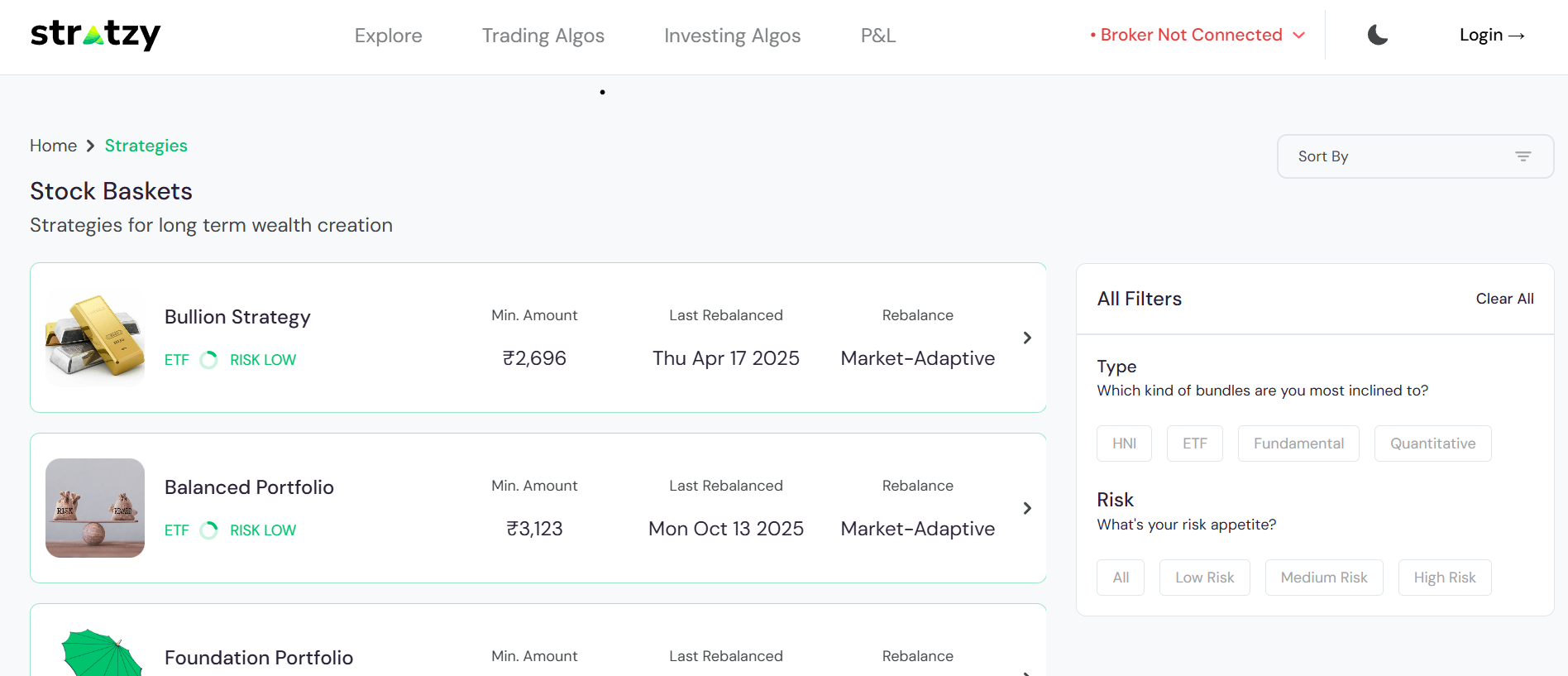
These are rule-based baskets of stocks or ETFs, designed using quantitative or thematic frameworks.
Examples include:
- Momentum strategies
- Sector allocation models
- ETF-based portfolios
- Factor investing systems
These portfolios are typically rebalanced periodically, reflecting systematic asset allocation principles.
2. Algorithmic Trading Systems
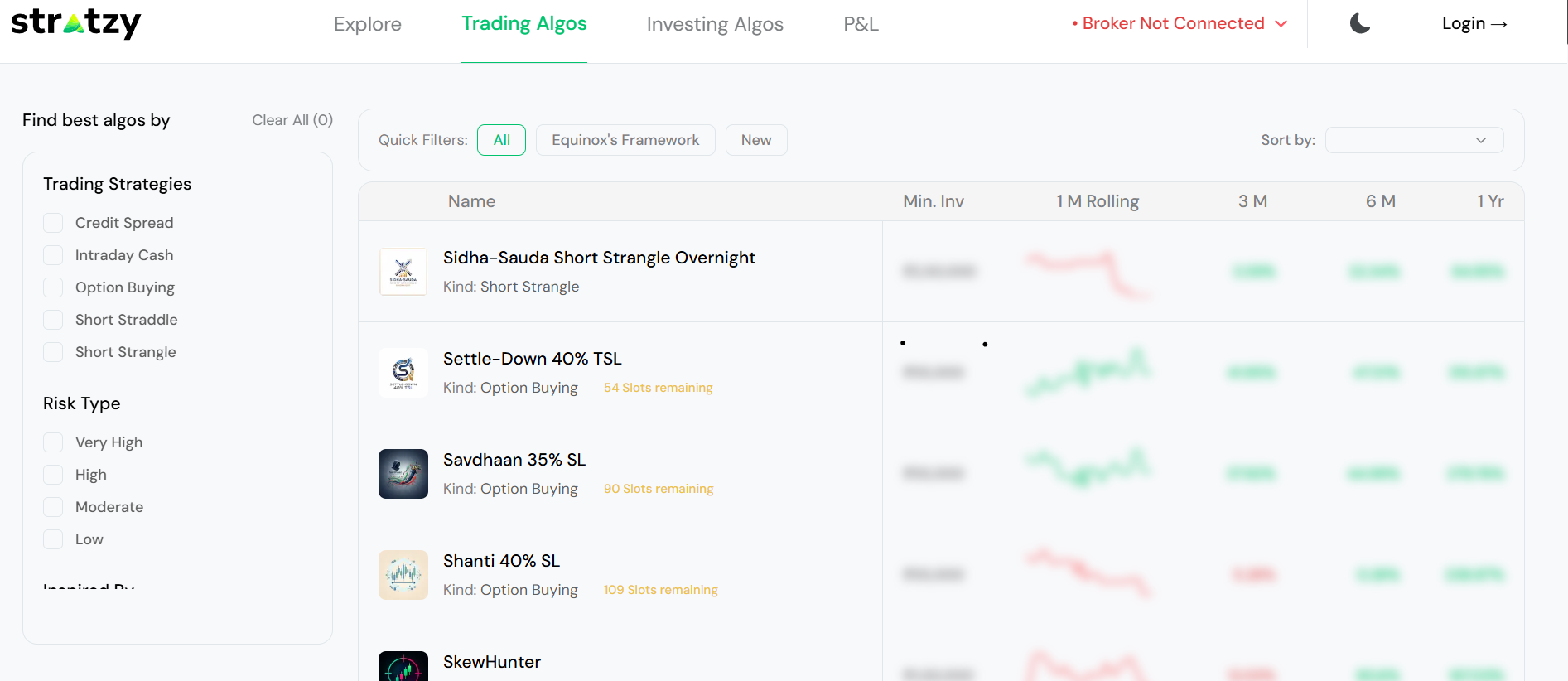
The platform provides pre-designed trading algos across:
- Options strategies (credit spreads, straddles etc.)
- Short-term trading frameworks
- Intraday systems
These algos generate entry/exit signals and may require manual confirmation for execution depending on regulatory constraints.
The app claims to offer 40+ pre-built algorithms across asset classes, indicating broad coverage of systematic trading approaches.
3. Investment Ideas & Research
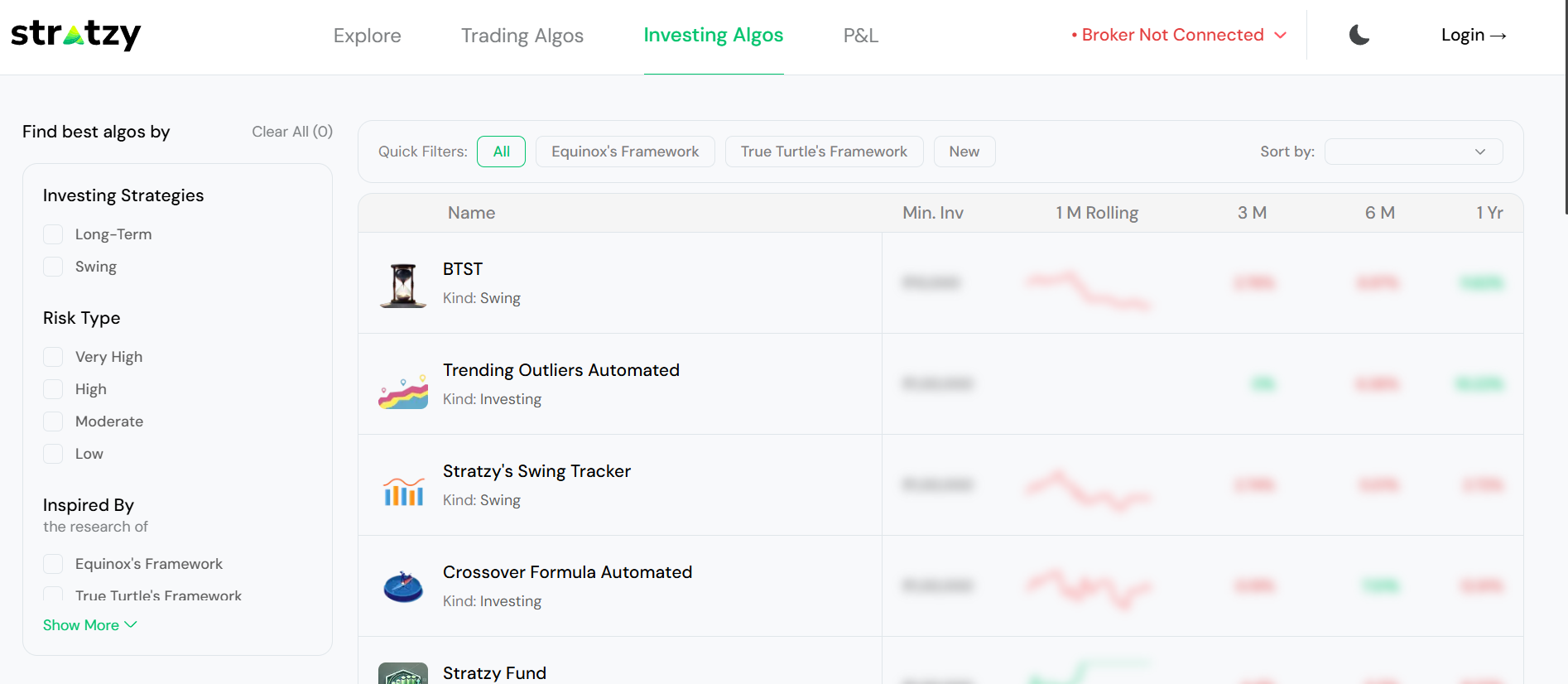
In addition to portfolios, Stratzy also provides:
- Stock recommendations
- Market insights
- Fundamental screening frameworks
This hybrid structure places it between:
- Robo-advisor
- Quant fund infrastructure
- Research platform
Pros of Stratzy
1. Systematic Investing Discipline
Stratzy’s biggest strength is encouraging rule-based investing, which can reduce behavioural mistakes like panic selling.
2. Institutional-Style Strategy Access
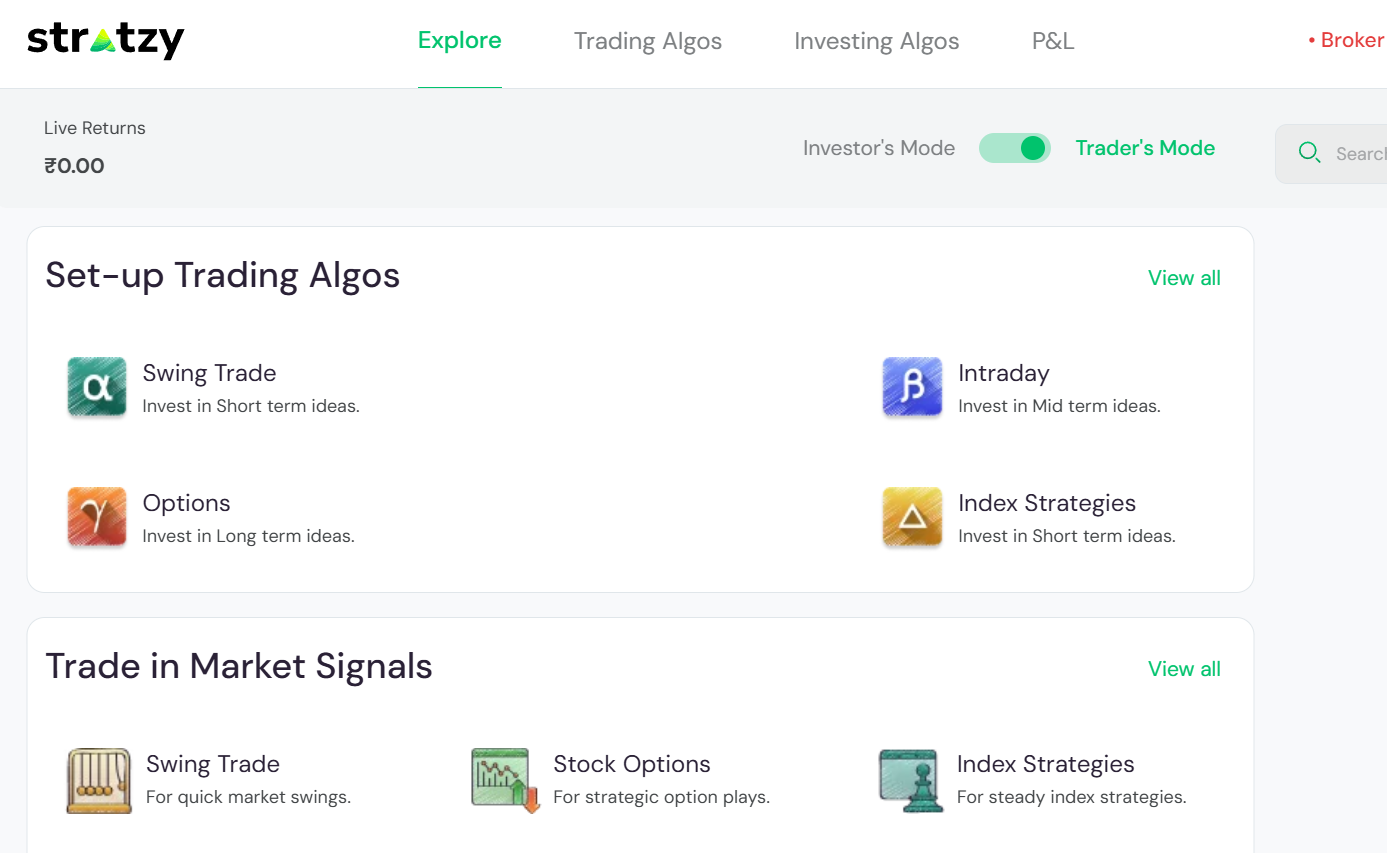
Retail investors can access:
- Quant frameworks
- Portfolio-level allocation models
- Structured rebalancing
This is still relatively rare in India’s retail ecosystem.
3. Broker Integration
Execution integration with multiple brokers improves usability and reduces operational friction.
4. Transparency in Strategy Metrics
Compared to many advisory products, Stratzy emphasizes:
- Backtests
- drawdowns
- performance visualization
This improves investor awareness of risk.
Cons and Risks
1. Backtest Dependence
Like most quant platforms, strategy performance relies heavily on historical modelling.
Investors must understand:
- Overfitting risk
- Market regime shifts
- Factor cyclicality
2. Execution and Cost Drag
Returns can be impacted by:
- Brokerage
- slippage
- tax drag
These costs are often underestimated by retail users.
3. Learning Curve
Systematic investing frameworks may feel complex to beginners.
4. Partial Automation
Unlike fully automated algo platforms, some execution steps still require user action.
5. Closed Strategy Ecosystem
Some critics argue that users cannot sufficiently test strategies before deploying real capital.
Actual User Reviews (Reddit & Public Blogs)
Community sentiment around Stratzy is mixed.
Negative Experience Example
A Reddit user wrote:
“Tried algos… all in losses… initially good, later bad.”
This reflects a common issue in quant investing:
- Strategies may perform well initially
- Later, they underperform due to market regime changes
Risk-Reward Criticism
A public blog reviewing daily performance suggested:
- Losses on red days were larger than gains on green days
- Some strategies had unfavourable risk-reward dynamics
The reviewer eventually stopped using the algos after continued losses.
Neutral Observations
Some users treat Stratzy as:
- Experimental allocation
- Learning tool for systematic trading
- Diversification mechanism
This suggests adoption is still in an early maturity phase.
Stratzy vs. Smallcase vs. Other Platforms: Where Does It Really Fit?
India’s fintech investing ecosystem is becoming segmented.
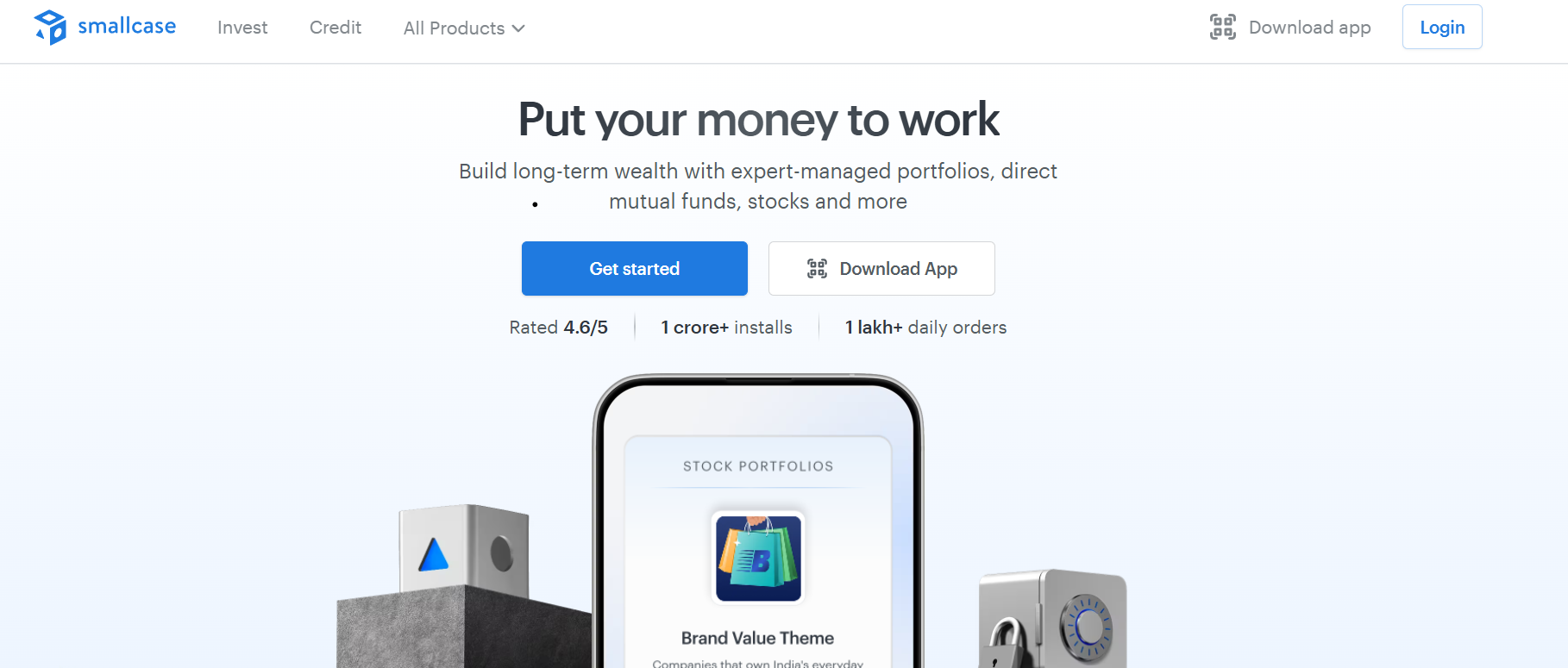
India’s retail systematic investing ecosystem is often misunderstood because multiple platforms appear similar on the surface but operate with very different philosophies and product structures.
To properly evaluate Stratzy, it must be compared with the largest and most established player: smallcase.
Stratzy vs smallcase
This is the core comparison investors should understand.
Investment Philosophy
- Stratzy → Quant systematic investing
- smallcase → Thematic + discretionary portfolios
smallcase portfolios are typically built around:
- Themes (EV, defence, IT etc.)
- Factor tilts (momentum, quality etc.)
- Manager discretion
Stratzy strategies are generally:
- Rules-driven
- Backtest-based
- Quant-structured
This makes Stratzy closer to quant funds, while smallcase is closer to actively managed baskets.
Portfolio Construction Style
smallcase:
- Human portfolio managers
- Narrative + macro themes
- Long-only bias
Stratzy:
- Algorithmic allocation rules
- Factor signals
- Tactical positioning possible
Thus:
smallcase = idea-driven
Stratzy = model-driven
User Experience and Simplicity
smallcase has a major advantage here.
Reasons:
- Strong brand trust
- Simple onboarding
- Massive broker integrations
- Retail familiarity
Stratzy:
- More analytical interface
- Higher learning curve
- Appeals more to quant-curious investors
Retail adoption dynamics show:
smallcase = mainstream
Stratzy = niche early adopters
Performance Expectations
smallcase portfolios:
- Typically benchmark-oriented
- Often thematic beta + moderate alpha
Stratzy strategies:
- Aim for factor alpha
- Higher turnover
- Potentially higher volatility
This creates different behavioural outcomes:
- smallcase → easier to hold
- Stratzy → harder psychologically during drawdowns
Transparency and Metrics
Stratzy generally emphasizes:
- Backtest data
- Drawdown charts
- Quant metrics
smallcase:
- More narrative-driven performance presentation
- Some quant portfolios but not core identity
This leads to:
Stratzy feels more “institutional.”
smallcase feels more “retail investing friendly.”
Automation and Execution
smallcase:
- Semi-manual rebalance
- SIP-like investing behaviour
Stratzy:
- Strategy signals
- Higher rebalance frequency possible
This means:
Stratzy behaves closer to a systematic trading infrastructure, not just investing.
Risk Profile
This is where investors often misunderstand the difference.
smallcase risks:
- Theme underperformance
- Manager selection risk
Stratzy risks:
- Factor crash risk
- Model risk
- Overfitting risk
- turnover cost drag
Thus:
Stratzy carries more quant risk, not necessarily more market risk.
Stratzy vs Other Fintech Platforms
Stratzy vs Univest
Univest focuses more on:
- Research advisory
- structured return narratives
Stratzy focuses on:
- systematic strategy execution
Stratzy vs Liquide
- AI analytics platform
- signal intelligence system
Stratzy is more:
- portfolio execution infrastructure
Stratzy vs Waya
Waya primarily offers:
- stock discovery
- AI insights
Stratzy offers:
- structured portfolio construction
Stratzy vs AlgoTest
Some comparisons suggest AlgoTest offers:
- better backtesting
- more strategy testing flexibility
While Stratzy focuses on plug-and-play strategy deployment.
Structural Risks Investors Must Understand
Before using Stratzy, investors should consider:
- Quant factor underperformance cycles
- Behavioural discipline requirements
- Strategy Crowding Risk
- live vs backtest performance gap
These risks are not platform-specific but inherent to systematic investing globally.
Final Verdict
Stratzy represents an important structural trend in Indian markets:
Retail access to institutional-style systematic investing.
Strengths:
- Encourages disciplined investing
- Provides quant portfolio frameworks
- Increasing institutional backing
Weaknesses:
- Performance volatility
- learning curve
- execution cost drag
Overall positioning:
Stratzy should be viewed as:
A quant investing infrastructure platform
NOT
A guaranteed alpha generator
It can be useful for:
- experienced investors
- quant believers
- diversified portfolio builders
It may not suit:
- passive SIP investors
- short-term return seekers
- low drawdown tolerance investors
