
Most personal finance & alternative investment enthusiasts in India may have already heard about a platform called Jiraaf. Jiraaf is a name that has been around in India’s alternative investment space for several years, but the platform has changed from its earlier avatar. What was earlier a platform offering all types of alternative investment opportunities has gradually evolved into a platform focused more strongly on bonds & other fixed income products like T-Bills. This shift makes Jiraaf worth revisiting, especially for investors who may have come across the platform in its earlier avatar.
In this Jiraaf review, we take a closer look at the platform’s current offerings, the investment, how it works, the associated risks, and how it compares with other platforms in the market. So let us get started!
What is Jiraaf?

Jiraaf was launched in the year 2021 by Saurav Ghosh and Vineet Agrawal, both professionals with experience in corporate finance and investments. The platform then focused on alternative fixed-income opportunities like corporate debt, invoice discounting, real-estate-backed investments, structured products, etc.
Jiraaf has since changed its positioning and is now a SEBI-registered Online Bond Platform Provider (OBPP), with its core offering focused on fixed-income securities. It currently lists investment options like corporate bonds, fixed deposits, Treasury Bills (T-Bills) and securitised debt instruments (SDIs) on its platform- both website & mobile apps.
Investment Options on Jiraaf
Jiraaf currently offers 4 fixed-income investments options- corporate bonds, government securities, Treasury Bills and securitised debt instruments (SDIs).
1. Corporate Bonds
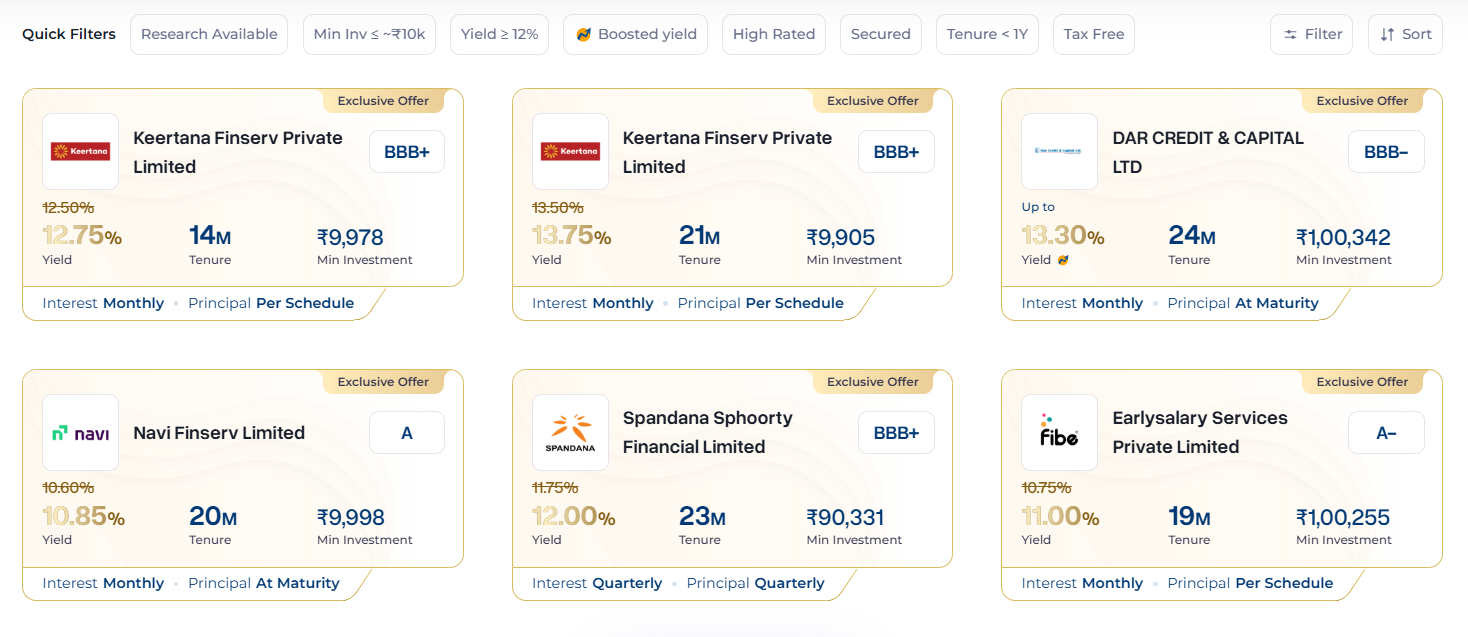
Corporate bonds are debt instruments issued by companies to raise money for various purposes like business expansion, working capital or refinancing existing debt. Jiraaf offers listed corporate bonds, which are traded on stock exchanges such as NSE and BSE and are regulated by SEBI. The platform currently lists bonds with typical tenures of 12–36 months (and some even with tenures of a few months), with indicative returns of around 8%–14%, although the actual yield varies by issuer and issue. There are bonds available with minimum investment of as low as Rs.10000 which makes it easy for all retail investors to enter this segment.
2. Fixed Deposits
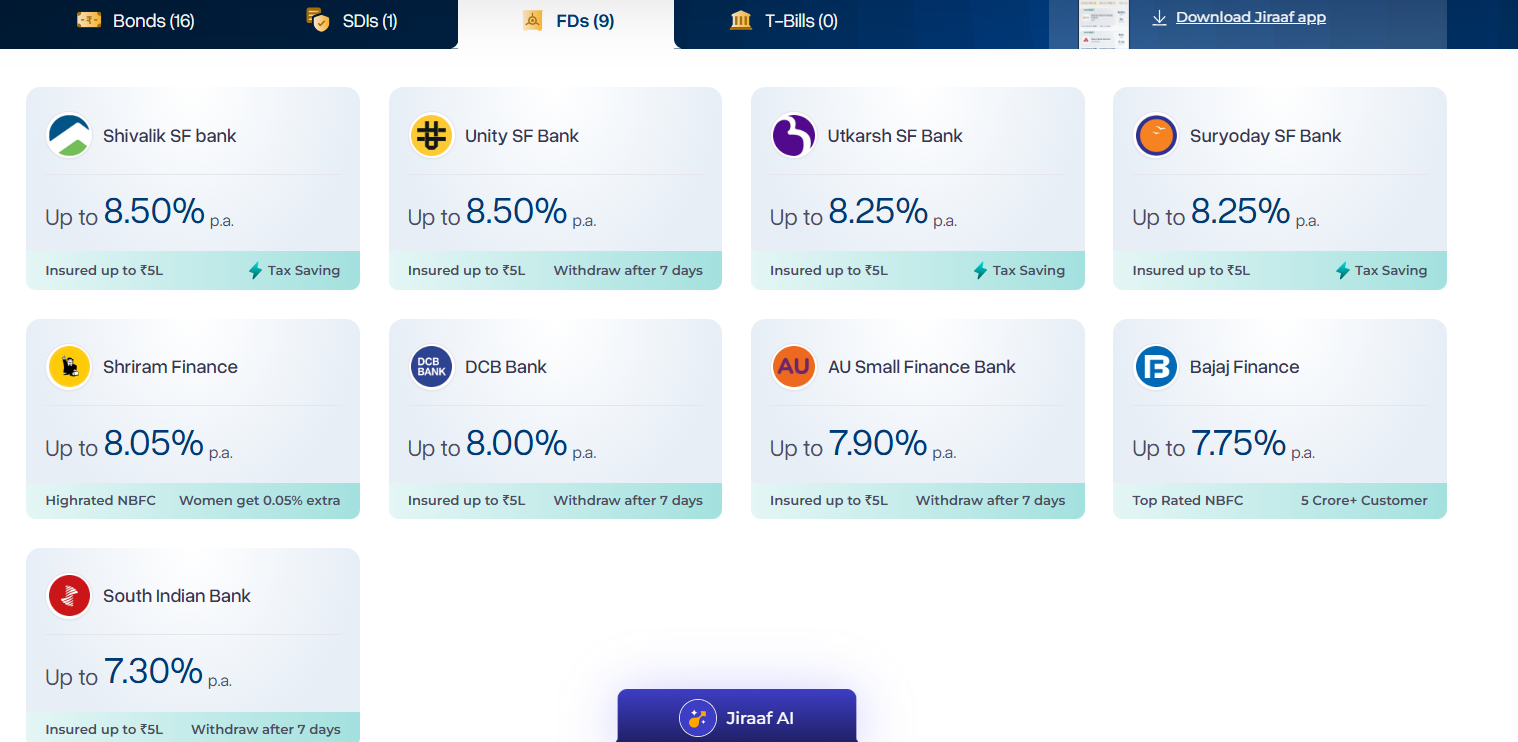
Jiraaf currently also offers high yield fixed deposits on its platforms. For this, they have tied up with regular banks, small finance banks & NBFC’s and offer their fixed deposits on their platform. As the time of writing this article, there are FDs from South Indian Bank, DCB Bank, AU Small Finance Bank, Shriram Finance, Bajaj Finance, Suryoday Small Finance Bank, Utkarsh Small Finance Bank, Unity Small Finance Bank, Shivalik Small Finance Bank, etc. listed on its platform.
3. Treasury Bills (T-Bills)
Treasury Bills are short-term government securities issued by the Government of India and are available in 91-day, 182-day and 364-day maturities. Unlike regular bonds, T-Bills do not pay periodic interest. They are purchased at a discount to their face value and the investor receives the full face value at maturity. Jiraaf currently lists T-Bills. However, they are not always available and get sold out fast.
4. Securitised Debt Instruments (SDIs)
SDIs are securities backed by a pool of income-generating assets, such as loan receivables, invoice receivables or other real assets. Instead of investing in the debt of a single company, investors get exposure to a pool of underlying assets, with the cash flows from those assets distributed to investors. Jiraaf currently lists SDIs with typical tenures of 12–36 months and indicative IRRs of around 8%–15%. However, returns depend on the performance of the underlying asset pool, so these instruments carry credit and other risks despite being secured by underlying assets. SEBI currently lists both SEBI regulated SDIs and RBI regulated SDIs on its platforms.
Is Jiraaf Safe to Invest?
Jiraaf is a SEBI-registered Online Bond Platform Provider (OBPP). Investments made through the platform are held in the investor’s demat account, rather than with Jiraaf. It also has a good reputation online among several investors. So, all in all, it is a safe platform to use.
However, there are risks pertaining to the investment products (and not the platform). Government securities and T-Bills carry relatively lower credit risk, while corporate bonds and SDIs carry higher risks, including the possibility of default and loss of principal. Investors should therefore check the issuer, credit rating, tenure and security of each investment before investing.
Jiraaf Alternatives
Jiraaf primarily deals with fixed income products like corporate bonds. For mentioning the alternatives, I am skipping products like T-Bills & Fixed Deposits since they are commonly available at almost the same yields at all the places. Following are alternatives to Jiraaf for bonds:
- Grip Invest
- The Fixed Income
- Altifi
- Aspero
- Golden Pi
- Stable Bonds
Conclusion
Jiraaf has evolved considerably from its early avatar as an alternative investment marketplace and is now primarily focused on fixed-income investments which are regulated. With options including corporate bonds, fixed deposits, T-Bills and SDIs, the platform offers investors different choices based on their return expectations, investment horizon and risk appetite.
However, Jiraaf should not be viewed as a way to earn fixed or guaranteed returns. The risk varies across products, particularly with corporate bonds and SDIs. Investors should evaluate each opportunity carefully, understand the issuer and associated risks, and invest only after considering whether the product fits their financial goals.
