

India’s investment conversations usually revolve around equities, startups, or commercial real estate. Yet one of the most powerful long-term investment themes is quietly emerging from demographics rather than markets — the rise of senior living housing.
As India ages, the demand for specialized residential communities designed for retirees and assisted living is increasing rapidly. Unlike cyclical investment trends, demographic shifts unfold over decades, creating structural opportunities that tend to be more durable and predictable.
At the same time, investing in such opportunities has historically been difficult for individual investors due to large capital requirements and operational complexity. Platforms like Alt DRX are attempting to bridge this gap by enabling fractional participation in professionally managed real estate portfolios.
This article explores why senior living is becoming a compelling alternative investment and how Alt DRX is making participation possible.
India’s Ageing Population: The Core Investment Thesis
India currently has more than 156 million citizens aged 60 and above, and this number is projected to grow significantly:
- Around 191 million seniors by 2030
- Over 346 million by 2050
The elderly share of the population is expected to nearly double during this period.
Unlike short-term economic cycles, demographic trends are highly predictable. People age regardless of market conditions, making sectors tied to ageing populations structurally resilient.
However, the infrastructure required to support this ageing demographic is severely underdeveloped.
The Demand–Supply Gap
Organized senior living penetration in India stands at roughly 1.3%, compared with 6–11% in developed markets such as the US and Australia.
Current organized supply includes:
- Approximately 18,000 senior living units nationwide
- About 7,500 assisted-living care units
Meanwhile, the addressable demand already exceeds one million seniors and continues to expand rapidly.
For investors, such imbalances often signal long-term growth potential.
Why Senior Living Demand Is Accelerating
Several socio-economic shifts are reshaping how ageing is experienced in India.
1. Rise of Nuclear Families
About 52% of Indian households are now nuclear families. Traditional multi-generational living arrangements are declining, reducing informal eldercare support.
2. Independent Senior Lifestyles
Nearly 26% of urban seniors live alone or only with a spouse, increasing demand for community-based living environments.
3. Healthcare Integration Needs
Approximately 27 million seniors require specialized medical care, and 30–35% may eventually require assisted living support.
Senior living communities address these needs through integrated services, including healthcare access, security, recreation, and social engagement.
Why Senior Living Works as an Asset Class

Senior living real estate combines characteristics of multiple asset classes:
| Attribute | Investment Impact |
|---|---|
| Residential housing | Stable underlying demand |
| Healthcare linkage | Long tenant duration |
| Community services | Premium pricing |
| Demographic tailwinds | Structural growth |
According to industry projections:
- Current market size: ₹15,500 crore
- Expected to reach ₹64,500 crore by 2030
- Growth rate: roughly 27% CAGR
Senior living units typically command a 10–15% premium over standard residential housing because of specialized design and services.
This makes the segment attractive for both rental yields and capital appreciation.
The Traditional Problem: Why Investors Couldn’t Participate
Despite strong fundamentals, individual investors rarely accessed senior living investments because:
- Buying property requires ₹50 lakh–₹2 crore capital
- Real estate is illiquid
- Property management is complex
- Institutional deals are private
- Diversification is difficult
Owning a single apartment exposes investors to concentrated risk and operational responsibilities.
This structural barrier limited participation — until fractional real estate platforms emerged.
How Alt DRX Makes Senior Living Investments Accessible

Alt DRX transforms real estate from a physical asset into a digitally accessible investment.
Instead of purchasing property directly, investors participate through a structured framework.
1. Special Purpose Vehicle (SPV)
A dedicated SPV acquires residential properties aligned with senior living themes. Investors own economic exposure through this entity rather than direct property titles.
2. Fractional Units — Alt.SQFT
Investors purchase Alt.SQFT units, representing fractional exposure to the real estate portfolio.
Indicative entry levels can begin around ₹9,500–₹10,000 per unit, dramatically lowering investment barriers.
3. Sequential Asset Acquisition Strategy
Properties are acquired gradually over several years, allowing diversification across multiple assets and locations.
4. Professional Property Management
A Master Property Manager oversees:
- Tenant onboarding
- Rentals
- Maintenance
- Operations
- Senior living services
Investors avoid day-to-day property hassles.
How Returns Are Generated
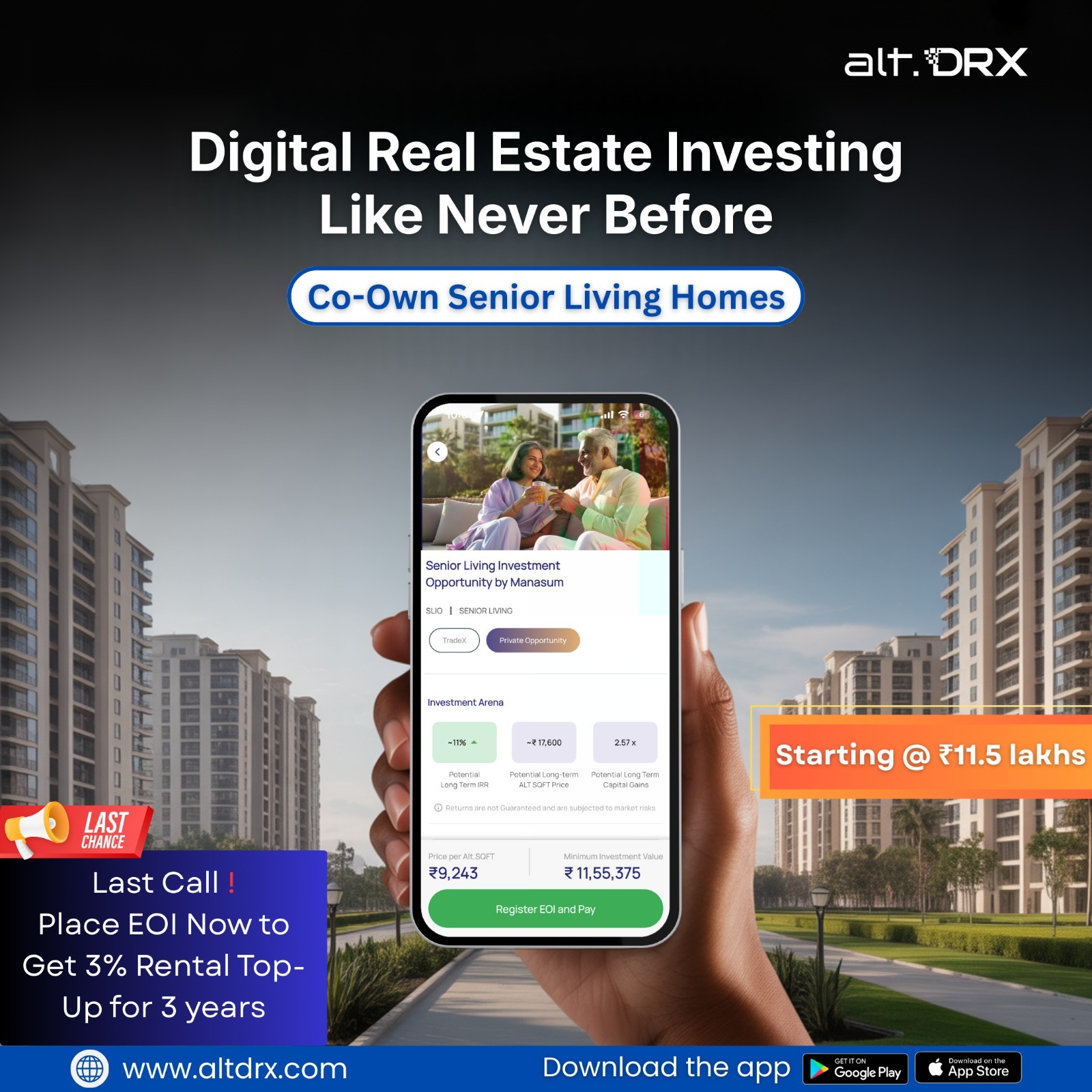
Returns typically come from two sources:
Rental Income
Properties generate periodic rental cash flows distributed to investors.
Capital Appreciation
As property values rise over time, investors benefit from appreciation.
Indicative projections include:
- Potential long-term IRR: ~11-15%
- Potential investment multiple: ~2.5-3.5×
- Investment horizon: 8–10 years
These are projections and depend entirely on asset performance.
Key Benefits of Alt DRX for Investors
Lower Entry Barrier
Fractional ownership allows participation without large capital commitments.
Diversification
Exposure across multiple properties instead of a single apartment.
Professional Execution
Institutional-style asset management improves operational efficiency.
Digital Ownership Experience
Investors can monitor holdings online and potentially trade units on the platform marketplace (subject to liquidity).
Access to Emerging Themes
Retail investors gain exposure to demographic-driven sectors like senior living.
Why Residential Senior Living Over Commercial Real Estate?
The investment thesis emphasizes residential assets because:
- Residential rentals adjust with inflation
- Demand comes from end users, not just investors
- Work-from-home trends impact offices more than housing
- Residential assets are typically easier to exit over time
Senior housing adds another layer of demand stability.
Risks Investors Should Understand
Real estate fractional investing carries risks that must be considered carefully:
- Liquidity risk — buyers may not always exist
- Market risk — property values fluctuate
- Performance risk — rental income may vary
- Legal and regulatory risks
- Economic downturn impacts
Importantly, investment returns are not guaranteed and depend on property performance.
The Bigger Trend: Financialization of Real Estate
Alt DRX represents part of a broader evolution in investing.
Historically:
- Real estate = physical ownership
Increasingly:
- Real estate = financial exposure via platforms
Just as mutual funds democratized equities and REITs institutionalized commercial real estate, fractional platforms aim to make residential real estate investable at scale.
Senior living sits at the intersection of:
- Demographic megatrends
- Housing demand
- Healthcare infrastructure
- Alternative income investing
Final Thoughts
Senior living real estate may become one of India’s most important alternative asset classes over the next two decades.
The investment logic is straightforward:
- India is ageing rapidly.
- Organized senior housing supply is extremely limited.
- Demand visibility is unusually strong.
- Financial platforms are lowering access barriers.
Alt DRX’s model attempts to connect these forces by enabling investors to participate in real estate portfolios that were previously accessible only to institutions or high-net-worth investors.
For long-term investors seeking diversification beyond equities and traditional fixed income, senior living investments — enabled through fractional platforms — represent a theme worth watching closely.
Disclosure: Investments involve market, liquidity, and performance risks. Returns mentioned are indicative and not guaranteed. Investors should review official investment documents before participating.
