
India’s investment landscape has evolved far beyond traditional mutual funds and PMS. For HNIs, family offices, and corporate treasuries, Alternative Investment Funds (AIFs) and the newer Specialised Investment Funds (SIFs) have become essential portfolio tools.
But these products are often misunderstood — leading to wrong expectations, liquidity shocks, and poor outcomes.
This guide explains:
-
What AIFs and SIFs really are
-
How each category works
-
Real examples of strategies and funds
-
Clear comparisons so you know what to choose and why
What Are AIFs in India?
Alternative Investment Funds (AIFs) are privately pooled investment vehicles regulated by the Securities and Exchange Board of India.
They allow investment strategies not permitted in mutual funds, such as:
-
Private equity & venture capital
-
Private credit & distressed assets
-
Real estate
-
Long–short equity & derivatives
-
Quant and arbitrage strategies
AIFs are meant only for sophisticated investors, not retail.
SEBI Classification of AIFs (Big Picture)
SEBI classifies AIFs into three categories, based on risk, strategy, and asset type:
| Category | Core Purpose |
|---|---|
| Category I | Early-stage & impact investing |
| Category II | Private equity, credit & real assets |
| Category III | Hedge-fund-like trading strategies |
Let’s go deep into each.
CATEGORY I AIF – Venture Capital, Early Stage & Infrastructure
What Category I AIFs Do
Category I AIFs invest in early-stage, unlisted, illiquid assets that need long-term capital.
These include:
-
Venture Capital funds
-
Angel funds
-
SME funds
-
Infrastructure funds
-
Social venture funds
How Returns Are Generated
Returns come from equity value creation, not regular income:
-
Business growth
-
Market share expansion
-
Valuation multiple increase
-
Exit via IPO or strategic sale
There is no steady cash flow.
Example
A VC fund invests in 20 startups
• 10 fail completely
• 7 return 1–2x
• 3 deliver 10–20xThe entire fund’s return depends on those 3 winners
Popular Category I AIF Examples
-
Peak XV Partners
- Blume Ventures
Risks You Must Understand
-
Extremely high failure rate
-
No liquidity for years
-
Valuations are subjective
-
One bad vintage year can hurt permanently
Category I vs Category II
| Aspect | Category I | Category II |
|---|---|---|
| Asset stage | Early | Mature |
| Cash flows | None | Possible |
| Failure rate | Very high | Moderate |
| Risk | Extreme | High |
Who should invest:
✔ Family offices with surplus capital
❌ Anyone needing visibility or liquidity
CATEGORY II AIF – Private Equity, Credit & Real Assets
(The Core of India’s AIF Market)
Category II is the largest and most widely used AIF category.
Sub-Types Within Category II
1️⃣ Private Equity / Growth Capital
-
Invests in profitable, growing unlisted companies
-
Focus on scaling operations and governance
Return driver:
EBITDA growth + exit valuation
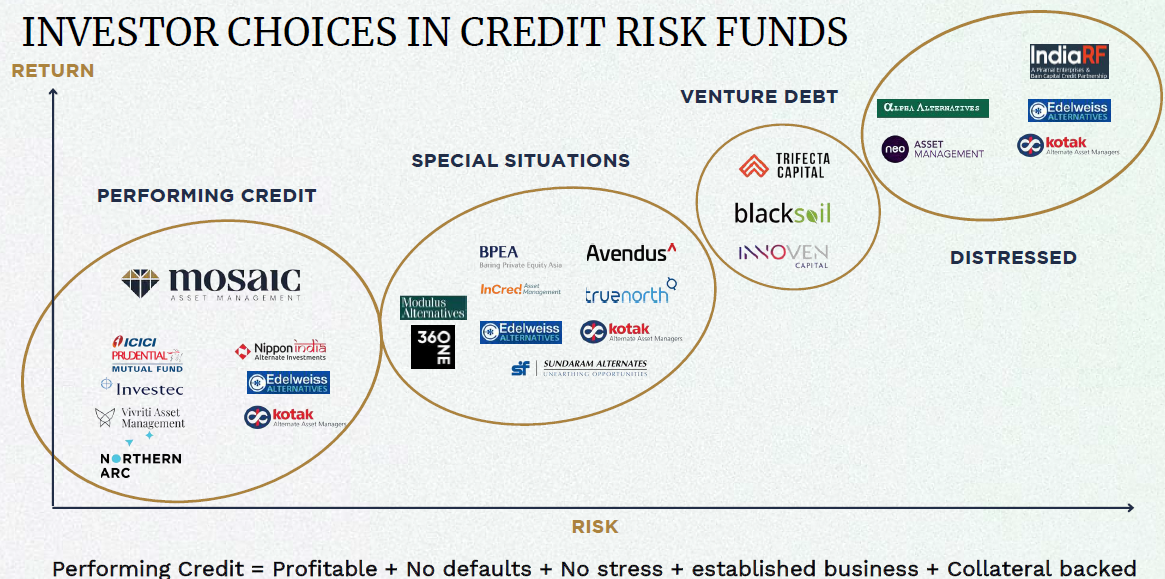
2️⃣ Private Credit / Structured Debt
-
Lends to companies outside banks
-
Often secured or structured
Return driver:
Contractual yield (12–22%) + downside protection
3️⃣ Real Estate AIFs
-
Commercial & residential projects
-
Rental yield + price appreciation
Return driver:
Project execution + real estate cycle

Example (Private Credit)
AIF lends ₹100 crore at 15% secured yield
Quarterly interest flows
Principal returned at maturity
Returns are yield-driven, not market-driven.
Typical Category II AIF Examples
-
Neo Special Situation Fund
- Edelweiss Alternatives
Risks (Often Underestimated)
-
Credit defaults
-
Real estate execution delays
-
Illiquidity
-
Manager risk
Many high-profile AIF issues in India happened in credit funds, not VC.
Category II vs Category III
| Aspect | Category II | Category III |
|---|---|---|
| Asset type | Unlisted | Listed |
| Leverage | ❌ | ✅ |
| Liquidity | Very low | Periodic |
| Returns | Growth / Yield | Alpha |
Who should invest:
✔ Family offices, corporate treasuries
❌ Investors chasing headline IRRs
CATEGORY III AIF – Hedge Fund & Trading Strategies
Category III AIFs are closest to global hedge funds.
What Category III AIFs Do
They invest in listed markets using:
-
Long–short equity
-
Arbitrage
-
Quant & systematic strategies
-
Volatility & options trades
Returns aim to be independent of market direction.
Example (Long–Short Equity)
Long high-quality stocks
Short weak balance-sheet stocks
Net market exposure: 20–30%
Goal: absolute returns across cycles
Example (Arbitrage / Quant)
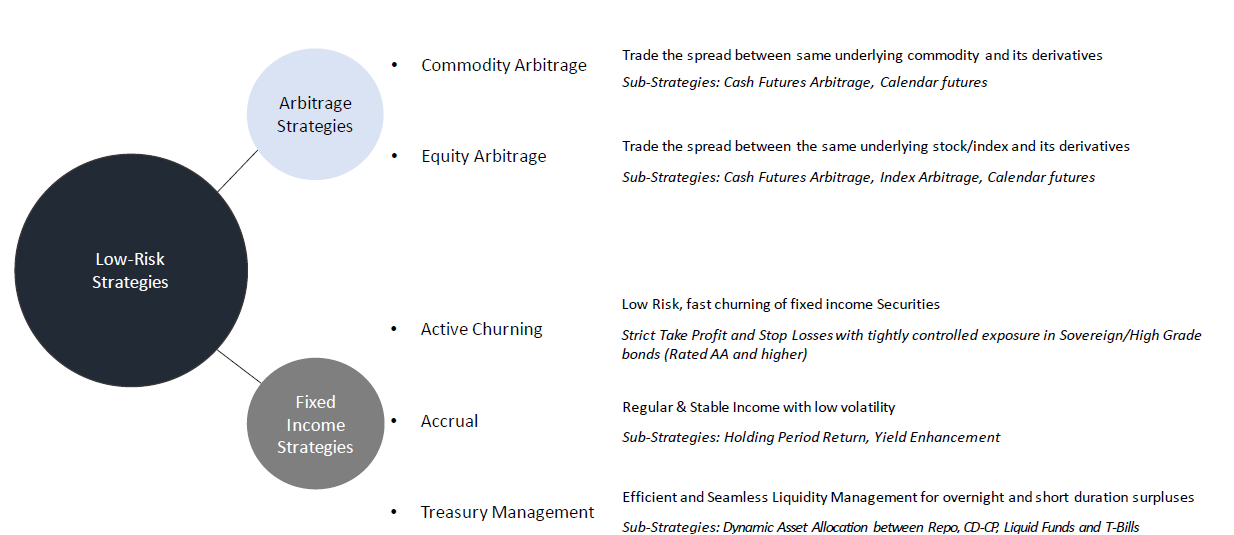
Capture pricing inefficiencies
Use leverage carefully
Many small trades, low per-trade risk
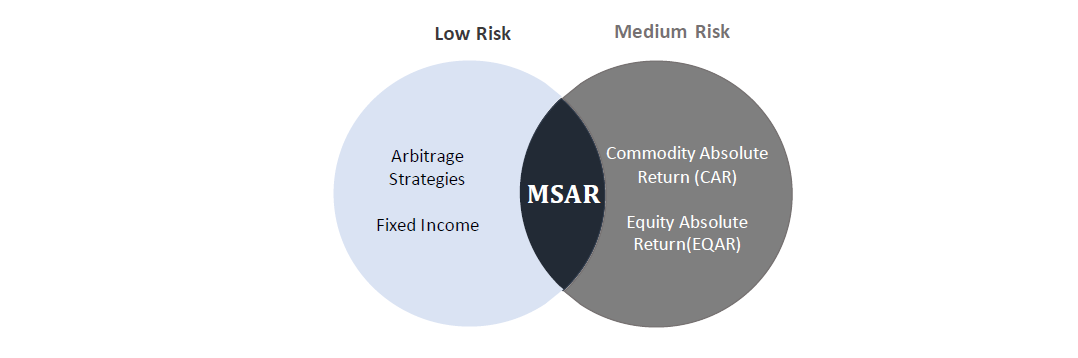
Typical Category III AIF Examples
-
TATA Absolute Fund
-
ASK Absolute Returns Fund
- Alpha Alternative Multi-Strategy Absolute Return Fund
Risks You Must Respect
-
Drawdowns can be sharp
-
Leverage amplifies mistakes
-
Strategy complexity
-
Liquidity gates during stress
Smooth return curves are often a red flag, not a comfort.
*Please note that some PMS have also taken AIF licenses to run long-only strategies
Category III vs SIF
| Aspect | Category III AIF | SIF |
|---|---|---|
| Min investment | ₹1 crore | ₹10 lakh |
| Leverage | High | Limited |
| Regulation | Flexible | Tight |
| Risk | High | Moderate–High |
SPECIALISED INVESTMENT FUNDS (SIFs) – The Middle Layer
SIFs were introduced to bridge the gap between mutual funds and AIFs.
What Is a SIF?
A Specialised Investment Fund (SIF) is:
-
Offered by mutual fund houses
-
Allowed advanced strategies
-
Under strong MF-style governance
Think of SIFs as:
AIF-lite with guardrails
Strategies Commonly Used
-
Long–short equity (low net exposure)
-
Index option income strategies
-
Arbitrage & carry
-
Quant factor portfolios
Leverage exists — but tightly controlled.
Example (Option Yield SIF)
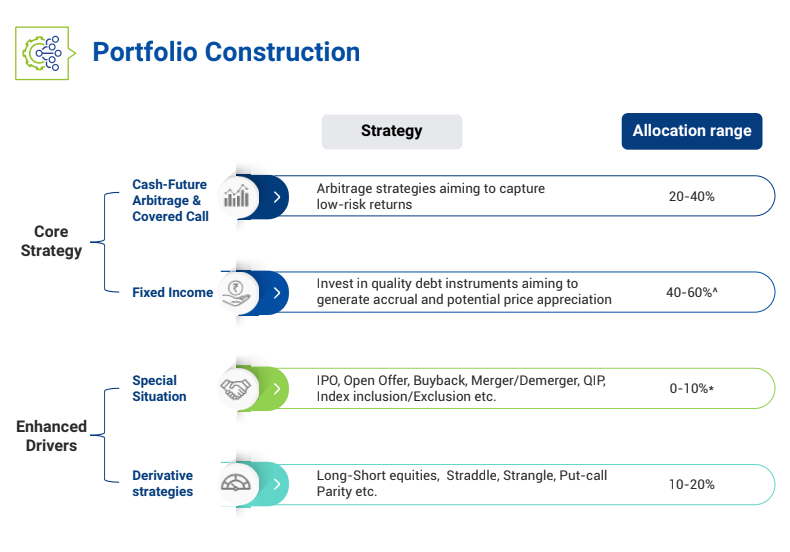
Sell index options within risk limits
Earn steady premium
Losses capped via rules
Typical SIF Examples
-
Edelweiss Altiva
-
SBI Magnum Hybrid Long Short
SIF vs PMS
| Aspect | SIF | PMS |
|---|---|---|
| Transparency | High | Medium |
| Rules | Defined | Discretionary |
| Min investment | ₹10 lakh | ₹50 lakh |
| Risk control | Systematic | Manager-driven |
Who Should Invest in SIFs
✔ Investors graduating from mutual funds
✔ HNIs below ₹1 crore per strategy
✔ Corporate treasuries
❌ Investors expecting MF-like stability
Minimum Investment & Process
Minimum Investment
-
AIF: ₹1 crore
-
SIF: ₹10 lakh
Process
1️⃣ Strategy & manager selection
2️⃣ Due diligence (PPM / SID)
3️⃣ KYC & documentation
4️⃣ Capital commitment/investment
5️⃣ Ongoing monitoring
How AIFs & SIFs Fit in a Portfolio
A realistic allocation approach:
-
60–70% → Mutual funds & direct equity
-
10–20% → SIFs (strategy diversification)
-
10–20% → AIFs (illiquidity & alpha)
Almost no sophisticated investor puts 100% in alternatives.
