
For years, premium real estate in cities like Mumbai, Gurgaon, and Bangalore was accessible only to HNIs and family offices who could deploy crores into under-construction luxury apartments. That is now changing.
A new model is emerging where fractional ownership platforms combine subvention payment plans with LLP/SPV-based co-ownership, allowing investors to access premium residential deals with ticket sizes as low as ₹5 lakh.

Platforms like Per Annum Estates and AFINUE are at the forefront of this shift, packaging high-end residential inventory into structured co-investment opportunities with projected 15–20%+ XIRR.
At first glance, these deals look highly attractive. A ₹5 lakh entry into a Santacruz luxury residence with 40% target returns over 2–3 years sounds compelling. But the return profile is very different from traditional rental-yield fractional ownership.
To evaluate these opportunities properly, investors need to understand how the subvention + fractional model works, where the IRR really comes from, and what can go wrong.
How Per Annum Estates and AFINUE Are Popularising This Model
Among the platforms shaping this category, Per Annum Estates has quickly emerged as one of the most visible names in residential fractional ownership. Its strategy focuses on early-stage entry into Grade A luxury residential projects across Mumbai, Gurgaon, Noida, and Bangalore, often using LLP/SPV structures and staggered payment plans that improve investor IRR by deferring capital deployment. The platform has already crossed ₹500 crore AUM within its first year, showing how strong investor appetite has become for this new residential co-ownership format.
AFINUE, on the other hand, appears to position itself with a more wealth-advisory and scenario-driven underwriting approach.
Many of its deal decks highlight LLP cash flow tables, hurdle-linked performance fees, and multiple exit pricing assumptions—such as ₹60,000 psf vs ₹65,000 psf sale scenarios—to show how returns change based on market outcomes. This framework helps investors understand the sensitivity of XIRR to exit timing, slab completion schedules, and resale pricing assumptions.
Together, both platforms represent the next evolution of Indian fractional real estate:
capital appreciation-led luxury residential exposure with embedded leverage-like economics.
Signup on AFINUE (Use Code MR630878)
Signup on Per Annum Estates for Free
What is the Property Subvention Fractional Model?
In simple terms, this is a capital appreciation strategy built around under-construction premium residential assets.
Instead of purchasing the apartment outright, multiple investors pool money through an- LLP, SPV or platform-managed trust structure. The pooled vehicle acquires one or more apartments in a luxury residential tower.
The real innovation is the subvention-style payment structure. A typical model may look like:
- 10% booking / earnest money
- 20% agreement + GST + registration + LLP setup
- 70% payable at the terrace slab/possession/exit
This means only part of the capital is deployed upfront. The remaining 70% gets paid much later, often close to the expected exit timeline.
That deferred capital deployment is what materially boosts headline XIRR.
Why the 30:70 Structure Looks So Attractive?
The biggest attraction is IRR enhancement through delayed cash outflow. Suppose an LLP acquires a ₹5 crore apartment.
Upfront deployment
- ₹50 lakh earnest money
- ₹1 crore agreement stage
- legal and platform setup costs
Deferred deployment
- ₹3.5 crore after 3–4 years
Now, assume the property price moves from:
- ₹60,000 psf → ₹65,000 psf
- or ₹34,500 psf → ₹48,000 psf
Because appreciation occurs on the full asset value, but capital is only partially deployed in the early years, the XIRR gets amplified.
This is why deal decks often advertise- 15% base case XIRR, 20% upside XIRR, 40% total return potential, etc. The key insight is this- the IRR is often driven as much by cash flow timing as by actual property appreciation.
How Returns are Generated in Fractional Investing + Subvention Model?
Unlike office fractional assets that generate rental yield, this model is primarily capital appreciation-driven.
Returns typically come from four drivers:
- Construction-led price discovery: As the project moves from launch to slab completion and near possession, the price per square foot usually reverts.
- Prime micro-market rerating: Locations like Santacruz East, Bandra East, Golf Course Extension, Whitefield can see strong repricing from infra upgrades and supply constraints.
- Scarcity premium: Luxury towers with branded developers and limited inventory can command premium resale values.
- Deferred payment leverage effect: This is the biggest XIRR enhancer. Even a 10–12% underlying property CAGR can translate into 15–20% XIRR due to staggered cash deployment.
Traditional Fractional Ownership vs Property Subvention Fractional Model
Many investors confuse this with leased office fractional investing. The two are fundamentally different.
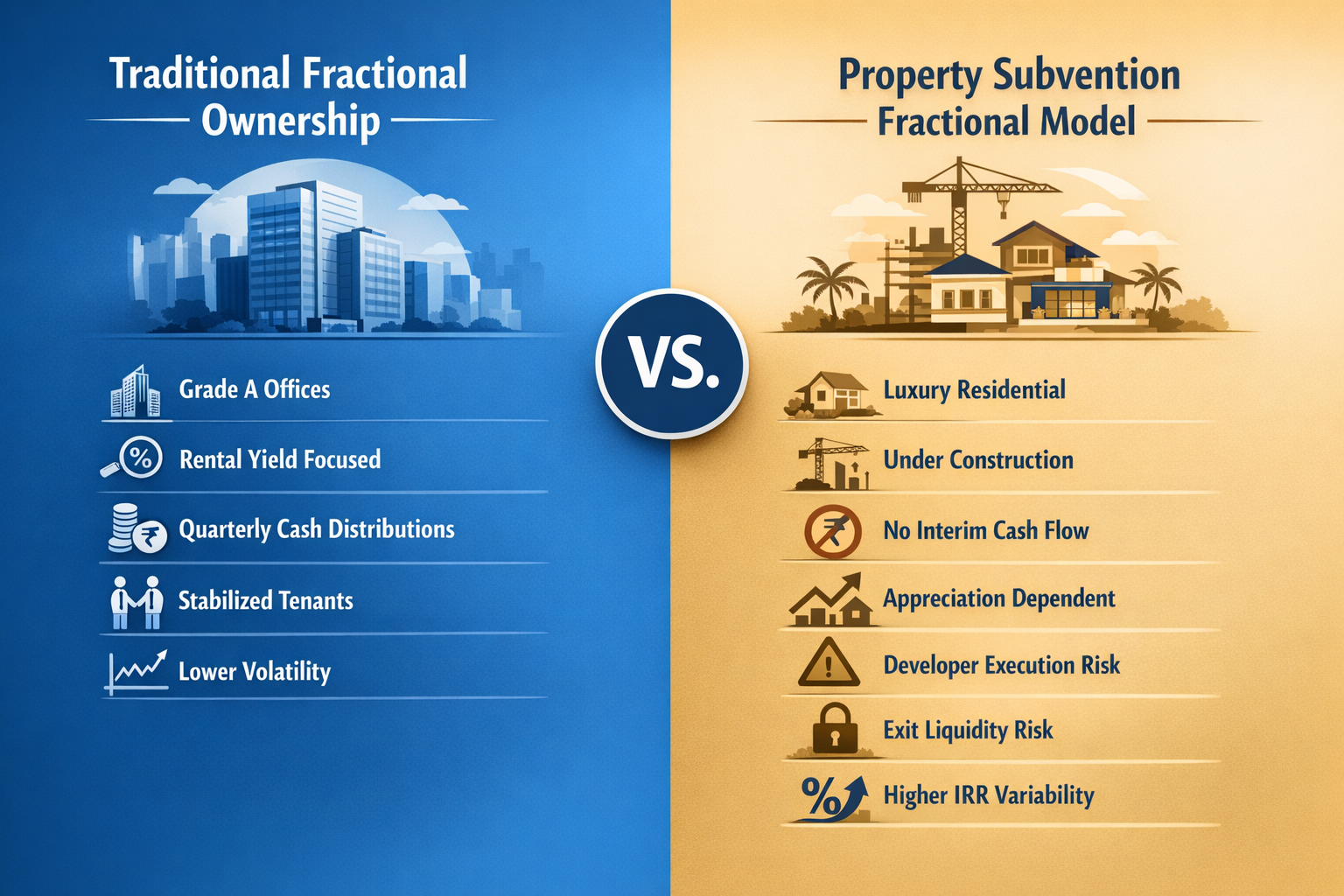
This makes the strategy feel closer to structured residential private equity than classic passive income investing.
Risks in Fractional Real Estate Investing
This is where glossy brochures can be misleading.
1) Construction delays
The biggest risk. If slab completion or possession gets delayed by 12–18 months:
- exit shifts
- final 70% gets pushed
- Resale liquidity weakens
- IRR can compress sharply
A projected 20% XIRR can easily fall to low double digits.
2) Exit liquidity
Luxury residential resale is not always liquid. The LLP needs end-user demand, HNI resale appetite, broker support, bulk transaction possibility, etc. A slow exit directly impacts returns.
3) Over-optimistic psf assumptions
Many models assume aggressive resale pricing. If the market clears lower than expected, returns can fall materially.
4) LLP governance
Investors must review voting rights, exit approval, waterfall distribution, replacement rights, dispute process, fee leakage, etc. This matters more than many retail investors realise.
5) Tax and fee drag
The before-tax XIRR can look attractive, but post-tax outcomes depend on: stamp duty, GST, brokerage, LLP taxes, long-term capital gains, performance fees above hurdle, etc. The gap can be meaningful.
How to Evaluate a Per Annum or AFINUE Deal?
Before investing, ask these 7 questions:
- Is the developer Tier 1? Godrej, Shapoorji, Mahindra, L&T, DLF type names reduce risk.
- What is actual nearby resale psf? Never rely only on launch brochure numbers.
- What is the platform hurdle rate? A carry above 15% XIRR is usually fairer.
- Who controls LLP cash and voting? Governance matters.
- Can the 70% be funded from resale proceeds? This improves capital efficiency.
- What if prices are flat? Stress test zero appreciation.
- What if exit is delayed by one year? This is the most important IRR sensitivity.
Conclusion
The subvention + fractional ownership model is one of the most innovative products in Indian alternative investments today. It solves three major barriers like low ticket access, premium residential participation, enhanced IRR through deferred payments, etc.
That’s why platforms like Per Annum Estates and AFINUE are seeing rising traction.
But investors should never mistake:
projected XIRR for assured return
This remains a capital appreciation bet on premium residential real estate with construction and exit risk. For investors who understand city micro-markets and can tolerate 3–5 years of illiquidity, it can be an excellent diversification sleeve.
For investors seeking predictable income, SM REITs or leased commercial fractional assets may be more suitable. The real edge here lies not in the brochure IRR, but in developer quality, entry price, realistic exit psf, governance terms, delay scenarios, etc.
That is where great deals are separated from marketing decks.
