
As the financial year ends on 31 March 2026, most investors focus on tax-saving investments like ELSS or insurance. However, one of the most powerful yet underused strategies is tax loss harvesting.
Done correctly, tax harvesting can:
• Reduce your current year tax liability
• Improve long-term portfolio returns
• Help rebalance your investments
• Enhance after-tax compounding over time
Importantly, this strategy is not limited to stocks — it can be effectively done using mutual funds and ETFs as well.
This guide explains tax harvesting in simple terms, Indian tax rules, real impact examples, calculator framework, and practical switching ideas.
What is Tax Loss Harvesting
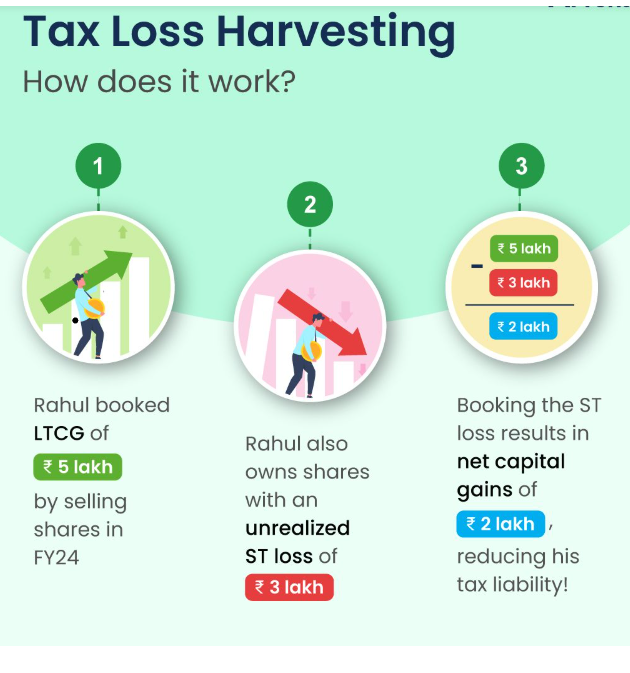
Tax loss harvesting means selling investments that are currently at a loss to offset gains you have already realised during the financial year.
Example:
- Profit booked in stocks = ₹2,50,000
- Loss in mutual funds = ₹1,00,000
Taxable gain becomes:
₹1,50,000 instead of ₹2,50,000
After harvesting, you can reinvest in a similar fund or ETF, ensuring that your market exposure remains unchanged.
This makes tax harvesting a tax-efficient portfolio adjustment, not a market timing strategy.
Why It Matters Before 31 March
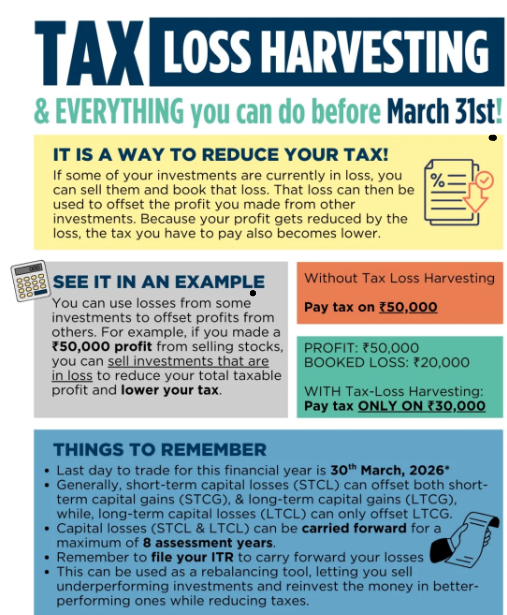
Tax harvesting must be completed before the financial year ends because:
• Capital gains tax is calculated FY-wise
• Losses must be realised to be set off
• Unused losses can be carried forward only if reported
• Market volatility near year-end creates harvesting opportunities
Missing the March deadline means losing the opportunity to optimise taxes for the current year.
Tax Harvesting Rules in India (2026)
Understanding taxation is crucial before implementing the strategy.
Equity (Stocks, Equity Mutual Funds, ETFs)
Short-Term Capital Gain (STCG)
Holding period: Less than 12 months
Tax rate: 20%
Long-Term Capital Gain (LTCG)
Holding period: More than 12 months
Tax rate: 12.5% above ₹1.25 lakh exemption
Loss Set-Off Rules
• Short-term capital loss (STCL) can offset both STCG and LTCG
• Long-term capital loss (LTCL) can offset only LTCG
• Unused losses can be carried forward for 8 years
This makes short-term loss particularly valuable for active investors.
Tax Harvesting Using Mutual Funds
Many investors believe tax harvesting applies only to stocks, but mutual funds are often easier to use.
Benefits:
• Diversified risk
• Simpler execution
• Behaviourally easier
• Ideal for SIP investors
Example:
Sell → Underperforming Flexicap Fund (loss)
Buy → Another Flexicap or Nifty ETF
This ensures:
• Loss realised for tax benefit
• Equity allocation maintained
ETF vs Mutual Fund Harvesting
ETF Advantages
• Intraday liquidity
• Precise execution
• Tactical switching possible
• Lower tracking error
Mutual Fund Advantages
• Suitable for long-term investors
• Easier for SIP portfolios
• Less behavioural stress
Best approach:
Use both strategically.
Real Example: Tax Harvesting Impact
Assume an investor has:
Realised LTCG = ₹3,00,000
LTCG exemption = ₹1,25,000
Taxable gain:
₹1,75,000
Tax payable:
₹21,875
Now suppose the investor harvests:
Mutual fund loss = ₹1,00,000
Revised taxable gain:
₹75,000
Tax payable:
₹9,375
Tax saved:
₹12,500
If this amount remains invested at 12% for 15 years:
Future value ≈ ₹68,000
This shows how tax harvesting improves long-term wealth creation.
Tax Loss Harvesting Calculator Framework
You can use this simple step-by-step approach.
Step 1: Calculate realised gains
STCG + LTCG during the financial year.
Step 2: Apply LTCG exemption
Deduct ₹1.25 lakh from long-term gains.
Step 3: Identify unrealised losses
From stocks, mutual funds, ETFs.
Step 4: Apply set-off rules
Adjust short-term losses first.
Step 5: Calculate tax saved
Tax saved = Loss harvested × applicable tax rate.
Long-Term Impact Formula
Future value of tax saved:
FV = Tax Saved × (1 + return)^years
This demonstrates the compounding power of tax efficiency.
Quick Tax Harvesting Impact Table
| Harvested Loss | Tax Saved (10% assumed) | Value After 15 Years (12%) |
|---|---|---|
| ₹50,000 | ₹5,000 | ₹27,000 |
| ₹1,00,000 | ₹10,000 | ₹54,000 |
| ₹2,00,000 | ₹20,000 | ₹1,08,000 |
| ₹3,00,000 | ₹30,000 | ₹1,62,000 |
Active investors in higher tax brackets benefit even more.
Practical Switching Ideas (Mutual Funds + ETFs)
The key principle:
Maintain portfolio exposure while realising loss.
Large Cap Allocation
Switch:
• Nifty ETF → Nifty Next 50 ETF
• Large cap mutual fund → Index fund
Midcap Allocation
Switch:
• Midcap fund → Flexicap fund
• Midcap ETF → Broad market ETF
Flexicap Allocation
Switch:
• One AMC flexicap → another AMC flexicap
• Flexicap → mix of large + mid ETFs
Sector Funds
If sector underperformed:
• IT / Pharma fund → Broad market fund
Avoid concentrated risk.
Debt Fund Tax Harvesting (Important After 2023 Rule Change)
Debt mutual funds are now taxed at slab rates.
This makes harvesting losses in:
• Long duration funds
• Gilt funds
• Credit funds
particularly valuable.
Switch to:
• Short duration
• Corporate bond
• Money market funds
This improves tax efficiency without exiting debt allocation.
You can check overlap in mutual funds using online tools like Fundoo!
SIP Investors: Hidden Opportunity
SIP portfolios contain multiple purchase lots.
Some units may be in loss even if the overall fund is positive.
Strategy:
• Redeem only loss units
• Reinvest immediately
This enhances tax efficiency without disturbing long-term investment discipline.
When Not to Do Tax Harvesting
Avoid harvesting if:
• You hold a high-conviction long-term compounder
• Exit loads are significant
• Loss is temporary market noise
• Portfolio allocation gets distorted
Tax optimisation should never compromise investment quality.
Final Thought: Tax Efficiency is a Compounding Multiplier
Investment success depends on:
• Asset allocation
• Behaviour
• Costs
• Taxes
Most investors optimise the first three.
Few optimise taxes.
But over decades:
Tax harvesting can increase wealth by 15–25%.
As 31 March 2026 approaches, reviewing your portfolio for tax harvesting may be one of the most impactful financial decisions you make this year.
Because in investing:
Returns earned matter — but returns kept after tax matter more.
Check out the Alternative Investments list below

In the “Real Example: Tax Harvesting Impact” provided wouldn’t tax payable be Rs.7,500 (10% of Rs.75,000)?
Hi Mahadevan,
LTCG is applicable only over INR 100,000 gains in a year.
Sorry, but isn’t it 12.% on gains above 1,25,000?
So, it should be 12.5% of 75,000 (3,00,000-1,00,000-1,25,000) which is 9,375
Please see this:
https://www.bajajfinserv.in/investments/long-term-capital-gain-tax-on-shares
You are correct, I have made the changes in the article